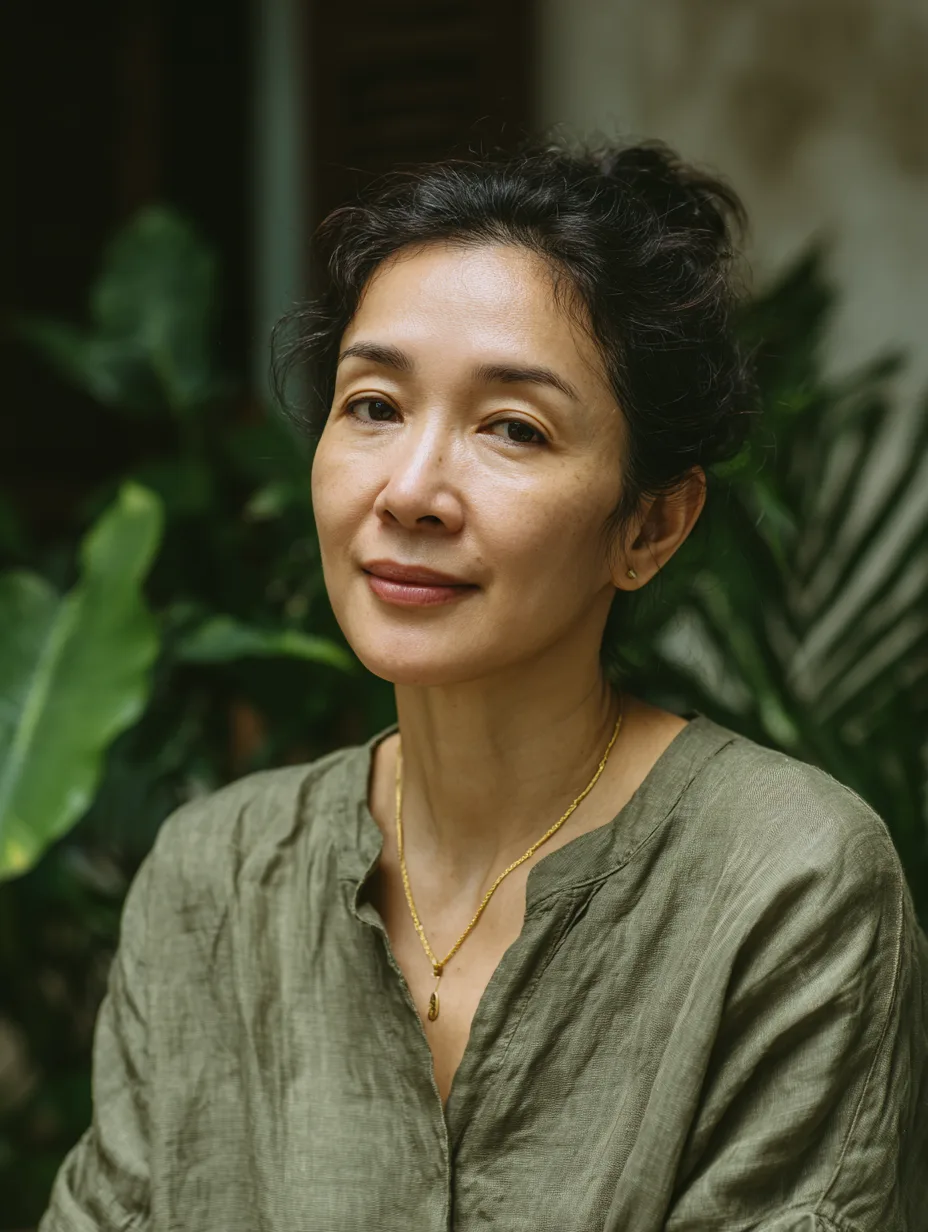
The monsoon rains over West Lake carry a particular weight. They arrive in Hanoi not as a gentle watering, but as a sudden, overwhelming sheet of grey that erases the horizon, turning the sky and the water into a single, continuous surface. Sitting in my therapy office on Dang Thai Mai street, I watch the motorbikes scatter toward the overpasses for shelter. The smell of wet asphalt mixes with the sweet, decaying scent of frangipani blossoms battered onto the pavement. I am forty-four years old. I live in the city my parents spent their entire adult lives trying to forget.
My parents fled Saigon in April 1975. They secured passage on a French cargo ship, carrying nothing but a small leather valise of photographs and the heavy, unnamable silence that settles into the bones of the exiled. That silence became the primary architecture of my childhood in the 13th arrondissement of Paris. We lived in a cramped apartment above a bustling pho restaurant on the Avenue de Choisy. Outside our window, the metallic shriek of the Metro Line 6 trains near the Nationale station provided a constant rhythm to our days. Inside, the air was thick with unspoken grief. My father worked at the Tang Frères supermarket, moving pallets of jasmine rice and canned lychees. My mother sewed garments for a boutique in the Marais. They loved me fiercely. They were also entirely absent, marooned in a country of memory that I could not visit.
I grew up suspended between two solid realities. At school, I was expected to inhabit the Cartesian clarity of the French educational system. We parsed Racine, memorized the dates of the Revolution, and learned to value sharp, rational debate. I was Albertine, a proper French girl who could conjugate the subjunctive without hesitation. Yet the moment I crossed the threshold of our apartment, I re-entered a spectral Vietnam. I ate bitter melon soup. I bowed to the altar of ancestors I had never met. I absorbed the hyper-vigilance of traumatized refugees who startled at sudden knocks on the door. I belonged wholly to neither world. I felt like a ghost haunting my own life, plagued by a terrible, isolating loneliness that no amount of academic achievement could cure.
Salvation arrived in the form of a minor rebellion. I was sixteen years old, suffocating under the pressure of the baccalaureate exams, when a classmate invited me to a mindfulness retreat in the Dordogne region of southwestern France. My parents, suspicious of anything resembling a cult, reluctantly agreed only because the center was run by a Vietnamese monk. I packed a duffel bag and took the train to Sainte-Foy-la-Grande. A battered white van carried us through rolling vineyards and oak forests to Lower Hamlet. This was Plum Village.
I expected rigid asceticism. I found a community of people walking very slowly, smiling at the morning dew, and drinking tea in absolute silence. Then I saw Thich Nhat Hanh. Thay, as we called him, did not exude the booming charisma of a spiritual guru. He was a slight, quiet monk in brown robes. When he walked, his feet seemed to kiss the earth. When he spoke, his voice possessed a softness that commanded total attention.
During a dharma talk in the meditation hall, he held up a blank sheet of paper. He asked us what we saw. We said we saw paper. He smiled and said that if we looked deeply, we could see the cloud floating in the paper. Without the cloud, there is no rain. Without the rain, the trees cannot grow. Without trees, there is no logger. Without the logger, there is no paper. The paper is empty of a separate self. It is full of the entire cosmos. He called this interbeing.
Sitting on my zafu cushion, listening to the rain hit the zinc roof of the hall, I felt a physical release in my chest. The teaching of the Heart Sutra—that form is emptiness and emptiness is form—was suddenly legible. My lifelong agony of being neither French nor Vietnamese dissolved. I was not an anomaly. I was a continuation. I contained the muddy waters of the Mekong and the grey currents of the Seine. I contained my mother’s survivor guilt and my father’s thwarted dreams. The logger, the cloud, the sunshine, the exile, the refuge. I was made entirely of non-me elements. To inter-be was to realize that isolation is an illusion created by a frightened mind.
The Architecture of the Nervous System
Many years later, I sat in a brightly lit auditorium at Paris Descartes University, training to become a clinical psychologist. I specialized in Interpersonal Psychotherapy. IPT is a heavily researched, time-limited treatment originally developed for major depression. It focuses strictly on the relational context of psychological distress: role disputes, complicated bereavement, role transitions, and interpersonal deficits. The Cartesian rigor of the French academic system suited the structured nature of IPT. We learned to map our clients' social circles. We learned to identify the exact moments when communication broke down.
Yet, as I began working with severe trauma, particularly with second-generation immigrants and refugees in the Parisian banlieues, the limits of pure cognitive and verbal therapies became glaringly apparent. You can help a client identify a role dispute perfectly. You can script a better way for them to express their needs to their spouse. None of this matters if their nervous system detects a lethal threat in a raised eyebrow or a slammed door.
Trauma destroys time. It takes a past event and traps it in the present tense of the physical body. When I read Bessel van der Kolk’s work detailing how the body keeps a literal score of past violations, the clinical puzzle began to make sense. Trauma memory is not stored as a narrative. It is stored as a tightening of the diaphragm, a shallowing of the breath, a racing of the heart. Stephen Porges’ polyvagal theory offered the exact neurobiological language for what I witnessed in my clinic. Porges mapped how the vagus nerve acts as our internal surveillance system. When a person is safe, the ventral vagal complex is active, allowing for social engagement, eye contact, and empathetic listening. When threat is detected, the sympathetic nervous system initiates fight or flight. If the threat is overwhelming and inescapable, the older, unmyelinated dorsal vagal branch takes over. The organism collapses. The client dissociates, going numb and deadened to the world.
My clients were living in chronic states of sympathetic hyper-arousal or dorsal vagal shutdown. Traditional talk therapy often felt like trying to install new software on a computer whose hardware was on fire. I needed a way to help them manually override their autonomic nervous systems. I found the answer not in the latest psychiatric journals, but in the Anapanasati Sutra, the Sutra on the Full Awareness of Breathing.
Consider the case of a client I will call Khoa. He was thirty-two, a successful architect in Paris, born to parents who survived the re-education camps in Vietnam. Khoa came to me for debilitating panic attacks. His shoulders were perpetually raised toward his ears. His jaw was locked. During our first three sessions, he spoke rapidly, intellectualizing his anxiety, desperate to figure out the "root cause" so he could fix it. He treated his body as an unruly machine that needed to be disciplined.
I asked him to stop talking. I asked him to place his right hand on his belly. I guided him through the first exercise of the Anapanasati Sutra. Breathing in, I know that I am breathing in. Breathing out, I know that I am breathing out. It sounds deceptively simple. For a traumatized nervous system, it is an agonizingly difficult task. Khoa’s breath was jerky, shallow, trapped entirely in his upper chest.
We did not force the breath. Forcing the breath triggers more sympathetic arousal. Instead, we observed it with the radical non-judgment I had learned on the oak-lined walking paths of Plum Village. I taught him the third exercise: Breathing in, I am aware of my whole body. Breathing out, I am aware of my whole body. I watched the physical transformation happen in real-time over the course of weeks. As Khoa learned to anchor his awareness in the rising and falling of his abdomen, his vagal tone began to shift. The slow, extended exhalation stimulates the parasympathetic nervous system. It sends a direct, biological signal to the brainstem: You are safe. The war is over. You can rest.
As his physiology stabilized, entering the ventral vagal state of social engagement, his capacity for insight returned. The cognitive work of IPT became possible. He could finally look at his relationship with his demanding father not through the lens of a terrified child, but from the grounded reality of an adult. The breath bridges the mind and the body. It is the only autonomic function we can consciously control.
The Practice of Beginning Anew
In 2018, I made a decision that shocked my Parisian colleagues and devastated my aging parents. I closed my practice in the 13th arrondissement and moved to Hanoi. I needed to breathe the air of the country that had lived inside me as a ghost. I needed to touch the soil. I rented this office near West Lake. I joined the local sangha. Fourteen years after my first retreat, I was ordained into the Order of Interbeing—Tiep Hien. I received my brown jacket and my Dharma name: True Harmony of the Heart.
Here in Vietnam, my clinical work shifted. Many expats seek me out, carrying the unique dislocation of living far from home. Many locals come to me, wrestling with the rapid modernization of a society still bearing the unhealed scars of war and poverty. Regardless of their passport, the suffering is remarkably similar. It is the suffering of disconnection.
One of the most powerful interventions I use comes directly from the monastic community. It is a communication practice called Làm mới, or Beginning Anew. I use it frequently with couples whose relationships have fractured under the weight of accumulated resentments. The practice consists of four distinct steps. It is a masterpiece of relational choreography.
A French couple, Elise and Thomas, arrived in my office on the verge of divorce. They had relocated to Hanoi for Thomas's engineering job, and the isolation had amplified their pre-existing fractures. Every conversation devolved into a bitter tally of past wrongs. Their nervous systems were completely dysregulated in each other's presence. Thomas would cross his arms and stare at the wall (dorsal vagal withdrawal). Elise would lean forward, voice raised, crying (sympathetic fight response).
I introduced Beginning Anew. The first step is "Flower Watering." One person speaks, acknowledging the positive qualities of the other. They must be specific. I made Elise look at Thomas. I asked her to name three things she appreciated about him. She resisted. The anger was too thick. But slowly, she recalled how he had stayed up all night holding their sick dog. She recalled his quiet reliability. As she spoke these truths, I watched Thomas’s posture soften. Flower watering is not mere flattery. Neurologically, it establishes cues of safety. It reminds the threat-detecting amygdala that the person sitting across from you is an ally.
The second step is expressing regrets for any unskillful actions one has committed. This requires immense vulnerability. Thomas admitted that he had been burying himself in work to avoid the tension at home. He owned his avoidance. He did not blame her for it.
The third step is expressing hurt. Only after the container of safety has been built through appreciation and accountability can the actual grievance be spoken. The rule is that the listener cannot interrupt. They practice the Plum Village technique of Deep Listening—the listening of Avalokiteshvara, the bodhisattva of compassion. You listen with only one purpose: to allow the other person to empty their heart. You do not listen to judge. You do not listen to formulate a rebuttal. You simply absorb the vibration of their pain.
To listen deeply is to offer another person the supreme gift of your presence. It is a physical act of holding space, requiring a stable spine and a soft front.
Elise spoke about her crushing loneliness in this foreign city. She spoke about feeling abandoned. Thomas listened. He breathed. Because his nervous system had been primed by the flower watering, he did not go into a defensive spiral. He stayed present. He heard the crying of the terrified child beneath his wife's anger. The fourth and final step is asking for support. Elise asked Thomas to spend just twenty minutes a day sitting on the balcony with her, without his phone, watching the traffic.
In clinical terms, Beginning Anew is a structured intervention that prevents interpersonal disputes from triggering trauma responses. In spiritual terms, it is the manifestation of interbeing. Elise’s loneliness was not separate from Thomas’s withdrawal. They were caught in an escalating dance of suffering. By changing the rhythm of the interaction, they changed the entire system.
The rain is finally slowing outside my window. The grey sky over West Lake breaks just enough to let a single shaft of late afternoon sunlight strike the water. The motorbikes emerge from beneath the bridges. The city resumes its chaotic, beautiful momentum.
I think of my parents in Paris. My mother’s hands, spotted with age, sewing a hem. My father sitting by the window, watching the rain hit the pavement of the Avenue de Choisy. Moving to Hanoi did not erase the sadness of their exile. Healing is rarely an erasure. Healing is the expansion of the container. It is the ability to hold the grief of 1975, the damp heat of this Vietnamese afternoon, and the precise, clinical knowledge of the vagus nerve simultaneously in one mind, in one body.
When I ring the small bronze bell on my desk to signal the end of a therapy session, the sound waves travel outward, bouncing off the plastered walls, passing through the glass window, and disappearing into the humid air of the capital. The vibration enters the bodies of the people sitting in the room. We take a breath together. We recognize the air entering our lungs. We recognize the air leaving our lungs. In that brief, silent space between the exhalation and the next inhalation, there is no therapist and no client. There is no France and no Vietnam. There is only the breath, moving through the shared body of the world, keeping us all alive for one more moment.