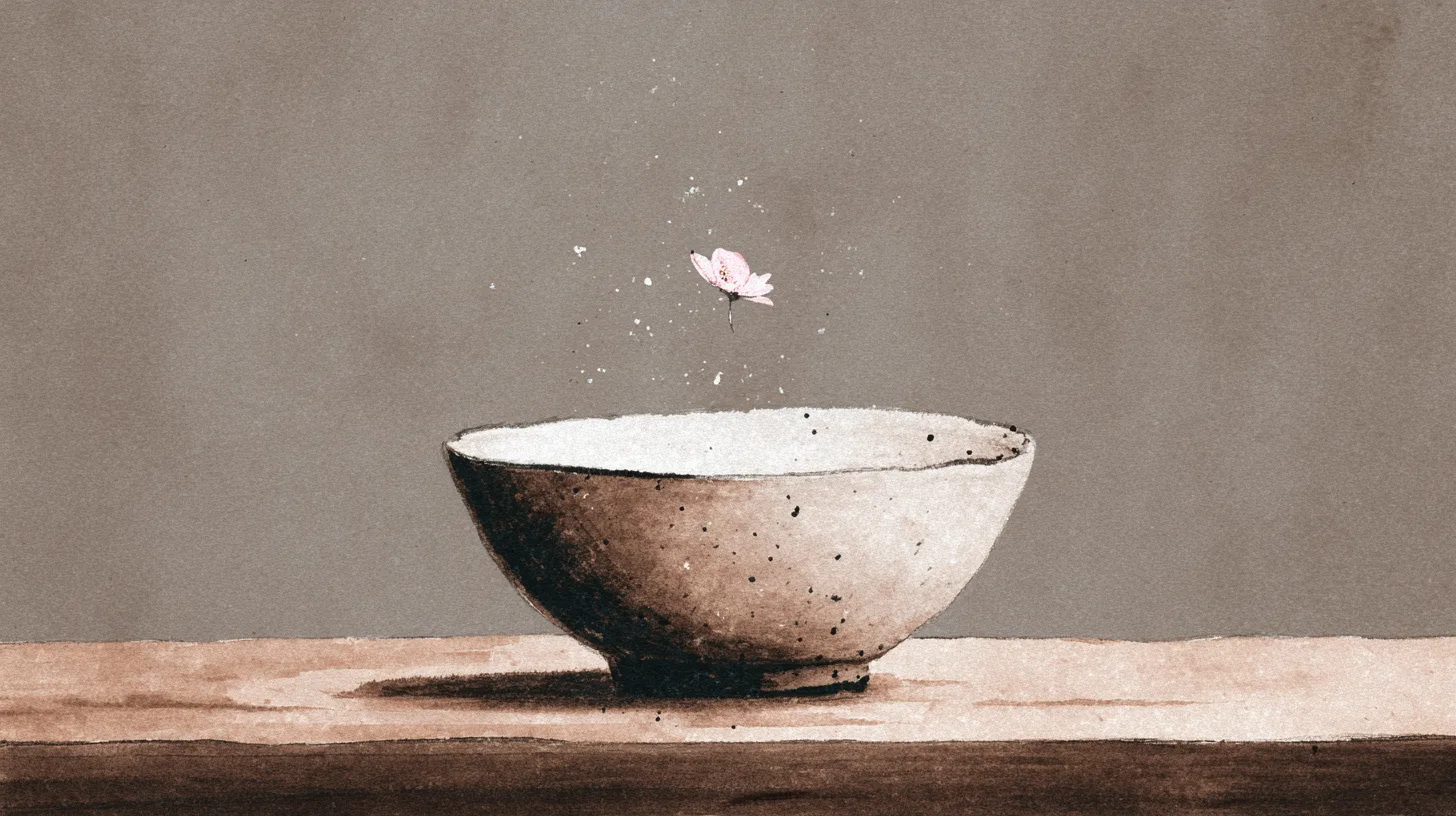
Hot water runs over ceramic. Scrubbing the rim, I use a cheap green sponge that smells faintly of lemon dish soap. There are three teacups sitting on the stainless steel drying rack in my clinic’s narrow back room. Clients leave their DNA, their stale breath, and their whispered complaints on these rims. Scrubbing them clean requires physical force. Every afternoon, caught between the fading Kyoto sunlight and the evening appointments, my hands stay submerged in the sink. The discipline of washing is exact.
My grandfather would have approved of this chore. He was a priest at Shokoku-ji, one of the massive Rinzai Zen temple complexes in the northern part of the city. Growing up within those walls felt less like spiritual training and more like living inside a museum curating silence. Incense smoke stained the sliding doors yellow. Monks swept the stone paths until the dirt itself seemed polished. Teenagers rarely care about form and emptiness. At fifteen, my religion was the distorted bassline of The Clash playing through stolen headphones.
Shokoku-ji attracts thousands of tourists seeking peace. To me, the compound was a gilded cage designed to suffocate youth under centuries of strict etiquette. I bought a Shinkansen ticket to Tokyo the morning after my eighteenth birthday. Leaving felt brilliant.
Koenji’s underground punk clubs offered an entirely different sensory diet. Sweaty walls and spilled beer replaced sandalwood. Piercing my own lip in a dirty bathroom mirror, I thought I had finally erased the temple from my blood. Then I met a bass player who lied automatically and fought violently. We spent five years shredding each other in freezing, uninsulated apartments. He drank my savings. My pride dissolved next. Leaving him required scraping up the last fragments of my sanity and dragging a damaged suitcase back up those ancient stone steps in Kyoto.
Defeated. Completely humiliated. Twenty-six years old.
The older monks said absolutely nothing about my bruised face. Someone simply handed me a bamboo broom. Sweeping the dry leaves from the northern courtyard became my first actual experience of Zen. Physical labor forces the mind to stay near the hands. You cannot obsess over a terrible ex when you are trying to gather wet pine needles into a neat pile.
The Trap of Competence
Years later, I moved to Melbourne to study psychology. Australia provided geographic distance and a sterile clinical vocabulary for human suffering. Acceptance and Commitment Therapy clicked for my brain immediately. ACT does not force clients to fix the ugly content of their thoughts. You simply change your relationship to the noise. Cognitive defusion acts as a wedge between the thinker and the thought. You watch the anxiety pass like a leaf floating down a stream. Western professors frequently joked about how "Zen" this all sounded. Smiling politely, I kept my opinions about their romanticized version of Buddhism to myself.
Setting up my private practice back in Kyoto was surprisingly easy. Local clients seemed to appreciate my bluntness. People pay therapists to listen, but they secretly want someone to stop them from spinning in circles. My sessions feature sudden stops. "Hold on," I will tell a client right in the middle of their practiced victim monologue. "Where is that feeling sitting in your body right now?"
This directness built my reputation. My schedule filled up. Waitlists formed.
Success makes therapists stupid. Earning a reputation breeds a quiet, dangerous arrogance. You start believing your own press. You assume you possess sharp eyes. An expert knows the clinical patterns. We memorize the diagnostic manuals and map out attachment styles before the client even finishes their first cup of tea. We see the matrix of human dysfunction and congratulate ourselves on our cleverness.
Shunryu Suzuki diagnosed this specific intellectual disease decades ago. "In the beginner's mind there are many possibilities, but in the expert's there are few." Western wellness influencers love printing that quote on coffee mugs. They strip the concept of shoshin of its teeth. Beginner's mind is not a cute attitude of childlike wonder. It requires severe, aggressive discipline. You have to willingly become an idiot every time the clinic door opens.
Knowing the Suzuki quote is easy. Living its instruction feels like walking into traffic blindfolded.
Kenji and Yuka walked into my office on a rainy Tuesday in early November. He wore a stiff gray suit, maintaining rigid posture while staring firmly at the baseboard molding. She sat wrapped in an expensive beige cardigan, clutching a leather-bound notebook filled with chronological grievances. Ten minutes into the intake assessment, my brain had them perfectly categorized.
Classic anxious-avoidant trap.
Yuka pursues with complaints. Kenji retreats into stony silence. Standard script. I charted a highly structured twelve-week treatment plan in my head while she cried about his refusal to speak during weekend dinners. My clinical confidence was absolute. I knew exactly how to fix them.
Weeks passed. We engaged in values clarification exercises. We practiced creative hopelessness. Nothing moved at all.
Kenji continued studying the floorboards. Yuka wept and read fresh accusations from her notebook. Frustration crept into my chest. I pushed harder, deploying advanced ACT interventions like tactical weapons. My case formulations were clinically flawless. Every technique was executed with crisp precision. The therapy itself was completely dead.
The Zen Interruption
During their fifth session, the temperature in the room dropped. Yuka was detailing a petty argument about folding laundry. Her voice climbed higher, growing tight and brittle. Kenji’s jaw clamped shut so hard the muscles in his cheek twitched. My mind anxiously sifted through a mental filing cabinet, selecting a defusion technique to break the escalation.
Suddenly, the absurdity of my own performance hit me.
Sitting in my expensive Danish chair, I was playing the role of the Great Healer. Clinging to my mental textbook, I remained entirely deaf to the actual human beings breathing heavily a few feet away. My expertise functioned as a thick glass wall. I knew too much. Too busy being a smart psychologist, I had stopped listening to the music of their pain.
Raising my right hand, I signaled a hard stop.
"Yuka. Kenji."
They blinked. The silence heavily expanded to fill the corners of the room. Rain hit the window glass outside.
"I have no idea what is happening here," I told them. My voice sounded strangely loud. "I have been treating you like a diagram on a whiteboard. I apologize. Let's drop the exercises completely. What is actually sitting in the space between you right now?"
Yuka slowly closed her leather notebook.
Looking up from the floorboards for the first time in an hour, Kenji met my eyes. His sclera were violently red. Tears spilled over his lower lashes before he even opened his mouth.
"I am terrified," he whispered.
He was terrified. Avoidance had nothing to do with his silence. Anger was miles away from his actual emotional state. He had discovered a hard lump on his neck three months ago. The exact same kind of lump his older brother found just before dying of aggressive lymphoma. Fear paralyzed him. He had not scheduled a doctor's appointment. He had not told his wife a single thing. Freezing her out was his clumsy, desperate way of preparing her for sudden widowhood.
Yuka let out a ragged noise that belonged in a hospital triage ward. It sounded like thick fabric tearing in half. Crossing the gap between their chairs, she grabbed his hands and buried her face in his suit jacket.
My attachment theory formulation was complete garbage. My clever cognitive interventions were practically insulting. These people did not need a mechanic to tune up their communication skills. Two terrified animals simply desperately needed a safe room to look at the terror of death together.
If I had maintained my expert stance, they would have divorced within a year. My competence almost destroyed their marriage.
Cognitive defusion works exactly the same way for the clinician as it does for the patient. Therapists must actively defuse from their own brilliance. We tell ourselves flattering stories about our professional identity. "I am a highly trained specialist." "I understand complex trauma." "I can read a room instantly." These concepts are just electrical impulses firing across synapses. Clinging to them blinds you to raw reality.
When you label a client as a "borderline" or a "narcissist," you stop seeing the breathing creature sitting on your couch. The label replaces the person. You interact with your own diagnostic category instead of the fluctuating, chaotic human reality unfolding in real time. Shoshin demands the destruction of these categories.
You must look at the person across from you and genuinely admit your total ignorance. Even if you have treated them forty times. Yesterday's depression is not today's depression. The anxiety they carry on Tuesday has a different texture than the anxiety they brought in on Thursday. Assuming you know what they will say guarantees you will miss the slight tremor in their voice when they say it.
Dropping the expert mind hurts. Ego prefers the safety of the clinical map. Not-knowing feels incredibly vulnerable. You sit there without armor, trusting that genuine curiosity will catch you when the textbook fails.
Which brings me back to the wet ceramic in my hands.
The water in the sink is getting tepid. I rinse the third cup thoroughly. Setting it upside down on the cotton towel, I watch a single drop of water roll down the dark glaze.
My next client arrives in exactly eight minutes. He is a forty-five-year-old salaryman struggling with alcohol addiction. Having treated dozens of middle-aged alcoholics, my brain automatically tries to hand me a neat summary of his psyche. It offers up statistics about relapse rates and notes on family systems theory.
I refuse to take the paperwork.
Pulling the plug, I let the dirty water drain away. I dry my hands on my canvas apron. Walking down the short hallway to my consulting room, I leave my theories in the sink. I sit down in my chair. Empty. Waiting.